
Tuesday, December 17, 2013

Friday, December 6, 2013


Tuesday, September 10, 2013

Thursday, September 5, 2013
A Grateful New School Year
As the new school year starts to settle in, educators seem to take a deep breath and brace for impact. Papers fly, pencil sharpeners roar, and we wipe the beads of sweat off our brow at the end of a fly-by-the-seat-of-your-pants, exhausting day. We collect the papers, clear the boards, wipe down the desks and get ready for the next bout of children exploding into our classrooms the very next day. We go home to our families, kids, friends....cats (for us single ladies) and say, "I'm already so tired, how will I find the energy to do it all over again tomorrow?"

I took a glimpse on the other end of the first days of school. I was invited to a Burmese dinner tonight. There were Karen missionaries, children, parents, and neighbors huddled around a small altar on the floor. They were praying Catholic prayers in Burmese, Karen, and English. Rosaries sparkled while hanging in the light from a nun's old hands. Children bowed their heads and hands and sat quietly.


As I sat in silence trying to follow, I wondered....why did we all get together? What's the point of this again? Why am I sitting here? So I asked. And I felt like I was sucker-punched.
They came together to pray for their children's new school year. They lit candles, gave offerings, and meditated on this thought for nearly an hour...going from home to home to repeat the ritual.
This mini paradigm shift changed my perspective from busy-teacher to humble servant. I realized that the hard times in the beginning of the school year aren't so bad. There are people who have gone through worse -- and are still able to find things to be grateful for. Something as taken for granted as a new school year. So this year, take the time to breathe, relax, and reflect on just what we're doing here. We're here to serve people who are grateful for what we do for them. Remember -- what teachers, principals, and school staff do is appreciated...even if we don't see it.

I took a glimpse on the other end of the first days of school. I was invited to a Burmese dinner tonight. There were Karen missionaries, children, parents, and neighbors huddled around a small altar on the floor. They were praying Catholic prayers in Burmese, Karen, and English. Rosaries sparkled while hanging in the light from a nun's old hands. Children bowed their heads and hands and sat quietly.


As I sat in silence trying to follow, I wondered....why did we all get together? What's the point of this again? Why am I sitting here? So I asked. And I felt like I was sucker-punched.
They came together to pray for their children's new school year. They lit candles, gave offerings, and meditated on this thought for nearly an hour...going from home to home to repeat the ritual.
This mini paradigm shift changed my perspective from busy-teacher to humble servant. I realized that the hard times in the beginning of the school year aren't so bad. There are people who have gone through worse -- and are still able to find things to be grateful for. Something as taken for granted as a new school year. So this year, take the time to breathe, relax, and reflect on just what we're doing here. We're here to serve people who are grateful for what we do for them. Remember -- what teachers, principals, and school staff do is appreciated...even if we don't see it.

Tuesday, May 7, 2013
GRASP Volunteers
Buffalo's International School #45's after school adult ESL program, GRASP (Great Results Always Start with Parents), is looking for volunteer teachers on Thursdays! Come in and share your knowledge and expertise on the English Language! Interested in working with refugees? There's lots to do!
Please contact Nicole Nichter to get started with this wonderful opportunity to do good and feel good! Phone: (716) 864-0875 Email: nicolenichter@gmail.com


Please contact Nicole Nichter to get started with this wonderful opportunity to do good and feel good! Phone: (716) 864-0875 Email: nicolenichter@gmail.com
Thursday, March 7, 2013


Thursday, February 21, 2013

Wednesday, February 20, 2013

Tuesday, January 8, 2013
What's the Password?
Try this little trick: Have students read and say a high frequency, decodable or new vocabulary word before they can enter the room. By posting a password near the door, students are revving up their brains before they even reach their seats!
Thanks Stephanie for the great idea!

Thanks Stephanie for the great idea!
Monday, January 7, 2013

Monday, December 31, 2012
Help Me! Signs
One of the first things ESL teachers need to give new students is survival phrases in English. A great strategy is to use Help Me! Signs. These little signs serve as signals that new students can wave to show the teacher when they are not understanding something. They are great for whole group instruction -- I've used them during read-alouds to post-it note pages that need to be re-explained. Give 'em a try!

All you need is index cards, large straws, tape, and a marker.


Write the phrases you want your children to know on the cards. Pre-teaching all of this vocabulary is the vital step! These sayings will help them later on learning more English or other languages and content vocabulary.

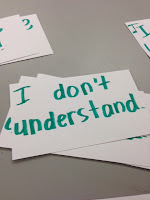


All you need is index cards, large straws, tape, and a marker.


Flip the cards over and tape the straws to the back of them....

And they're ready to use! Enjoy :)


Some of my cuties on pajama day!
Phoning in on Phonemic Awareness
Phonemic awareness, or the ability to recognize and manipulate phonemes (individual sounds in a language) is one of the most vital components to early literacy skills. Being able to recognize that sounds are related to symbols, characters, or letters and eventually words (phonics) leads to strong readers.

Just as metacognition ("thinking about thinking" or "knowing about knowing") is a general educational practice for all grades, metalinguistic awareness (the ability to objectify a language - or understand when you are speaking one or an other) needs to be highlighted when teaching ESL students literacy.
Since young children are learning to read and write and their metacognition and metalinguistic awareness are still being developed, explicit instruction of phonemic awareness (in preferably BOTH languages) helps students realize that they speak two languages.
Imagine if you were a young ESL-er riding on two sets of train tracks that take you to the same place; The train tracks represent language (the means/way of understanding a message) and the place represents the meaning or message of the communication act (the point of saying something). Since you don't know how to read and write yet, you don't SEE that you are riding on different tracks, but you can HEAR it.


This is why phonemic awareness is so important. Not only does it build literacy skills but it help differentiate the sounds between languages, which ultimately leads to the understanding of one's own bi- or multilingualism (metalinguistic awareness)!
A way I introduce metalinguistic awareness is that I tell my students, "You know you speak more than one language because you understand what your family says to you at home, and when you come to school, you understand what I tell you! Even though the sounds your family makes and the sounds I make are different, you still know what I'm saying!" (Despite metalinguistic awareness NOT being part of the general curriculum, it is incredibly important to language development and needs to be taught in ESL classrooms.)
Young ESL children are absolutely NOT the on the same playing field as native English speakers in regards to literacy. Their brains are competing to build a working system of understanding between two sets of sounds - or two languages. Phonemic awareness in both languages builds a foundation of bi-literacy. One great strategy to focus on phonemic awareness is using phones!

The phones are simply made plastic tubes with a curve. Students hold the phones up to their ear and mouth and speak into them so they can hear their own voices and they sounds they make. These are great for rote speaking practices, repeating, and daily routines where speaking is involved. Other teachers use them in areas when children hold the phones while reading a list of letters and sight words out loud. I've even witness some of my children exit their silent period with the use of these phones. They love speaking into them and hearing the sounds they make - give it a try! You'll definitely see some light bulbs on you bright, shining students!

 On a budget? Head to the local hardware store and pick up some elbow PVC piping. Works like magic (for less)!

METALINGUISITC AWARENESS
Just as metacognition ("thinking about thinking" or "knowing about knowing") is a general educational practice for all grades, metalinguistic awareness (the ability to objectify a language - or understand when you are speaking one or an other) needs to be highlighted when teaching ESL students literacy.
Since young children are learning to read and write and their metacognition and metalinguistic awareness are still being developed, explicit instruction of phonemic awareness (in preferably BOTH languages) helps students realize that they speak two languages.
Imagine if you were a young ESL-er riding on two sets of train tracks that take you to the same place; The train tracks represent language (the means/way of understanding a message) and the place represents the meaning or message of the communication act (the point of saying something). Since you don't know how to read and write yet, you don't SEE that you are riding on different tracks, but you can HEAR it.


PHONEMIC AWARENESS PRACTICE IN ESL
This is why phonemic awareness is so important. Not only does it build literacy skills but it help differentiate the sounds between languages, which ultimately leads to the understanding of one's own bi- or multilingualism (metalinguistic awareness)!
A way I introduce metalinguistic awareness is that I tell my students, "You know you speak more than one language because you understand what your family says to you at home, and when you come to school, you understand what I tell you! Even though the sounds your family makes and the sounds I make are different, you still know what I'm saying!" (Despite metalinguistic awareness NOT being part of the general curriculum, it is incredibly important to language development and needs to be taught in ESL classrooms.)
Young ESL children are absolutely NOT the on the same playing field as native English speakers in regards to literacy. Their brains are competing to build a working system of understanding between two sets of sounds - or two languages. Phonemic awareness in both languages builds a foundation of bi-literacy. One great strategy to focus on phonemic awareness is using phones!

The phones are simply made plastic tubes with a curve. Students hold the phones up to their ear and mouth and speak into them so they can hear their own voices and they sounds they make. These are great for rote speaking practices, repeating, and daily routines where speaking is involved. Other teachers use them in areas when children hold the phones while reading a list of letters and sight words out loud. I've even witness some of my children exit their silent period with the use of these phones. They love speaking into them and hearing the sounds they make - give it a try! You'll definitely see some light bulbs on you bright, shining students!


Being Culturally Responsive at Open House
Open house is a time for teachers and families to come together to share the growth of the children. It's important for teachers to showcase what English language learning children HAVE ACCOMPLISHED rather than what they have not -- especially when the parents may not be English speaking!

A culturally responsive Open House includes teachers stressing the importance and relavance of children learning to speak, read, write, and understand their home language. Although the parents may not know English, they know their home language -- which is a vital component of second language acquisition!


A culturally responsive Open House includes teachers stressing the importance and relavance of children learning to speak, read, write, and understand their home language. Although the parents may not know English, they know their home language -- which is a vital component of second language acquisition!
FIRST LANGUAGE LITERACY TRANSLATES TO SECOND LANGAUGE LITERACY!


A great strategy is for teachers to ask families to teach their children how to write their names in their native language. Teachers can provide resources for practice.

I was lucky to learn how to write my name in Tigrynia!

Tuesday, December 18, 2012

Thursday, December 6, 2012
What's for Dinner?
Eritrean food is! Eritrea is a small country on the coast of the Red Sea, neighboring Ethiopia. Their cuisine is similar to Ethiopian and just as tasty. Buffalo's Eritrean community is on the rise--so take advantage of their amazing culinary cuisine!
A former ESL student had us over for Beef Tibbs--a typical dish found in Ethiopian restaurants. First, they chopped the onion and fried it in a little oil.


A former ESL student had us over for Beef Tibbs--a typical dish found in Ethiopian restaurants. First, they chopped the onion and fried it in a little oil.


Next, they added finely chopped beef...
Next, they took out the injera (a crepe-like bread) and laid it on a large plate.
And finally, they served the dish by spreading the Tibbs over the injera.

REMEMBER! It is culturally apropriate to eat with only your right hand!
ENJOY!
Don't be a stranger to the refugee community -- they love to share their culture and cuisine!
See what's cookin' in your neighborhood :)
Wednesday, December 5, 2012

Friday, October 19, 2012

Saturday, October 13, 2012
Stephen Krashen
Stephen Krashen is one the forefathers in ESL education and his work has been studied in universities since it was hot off the presses, right along with Chomsky and Skinner. This video shows the importance of using SIOP components and makes the audience think of how instructional models should be used (at least it made me think of how explicit instruction is being used all wrong in some schools with ELLs). Though riddled with charming 1980s awkwardness, this video sums up the foundation of language learning.
Take a look at the 1980's superhero of SLA:
Subscribe to:
Posts (Atom)